Overview
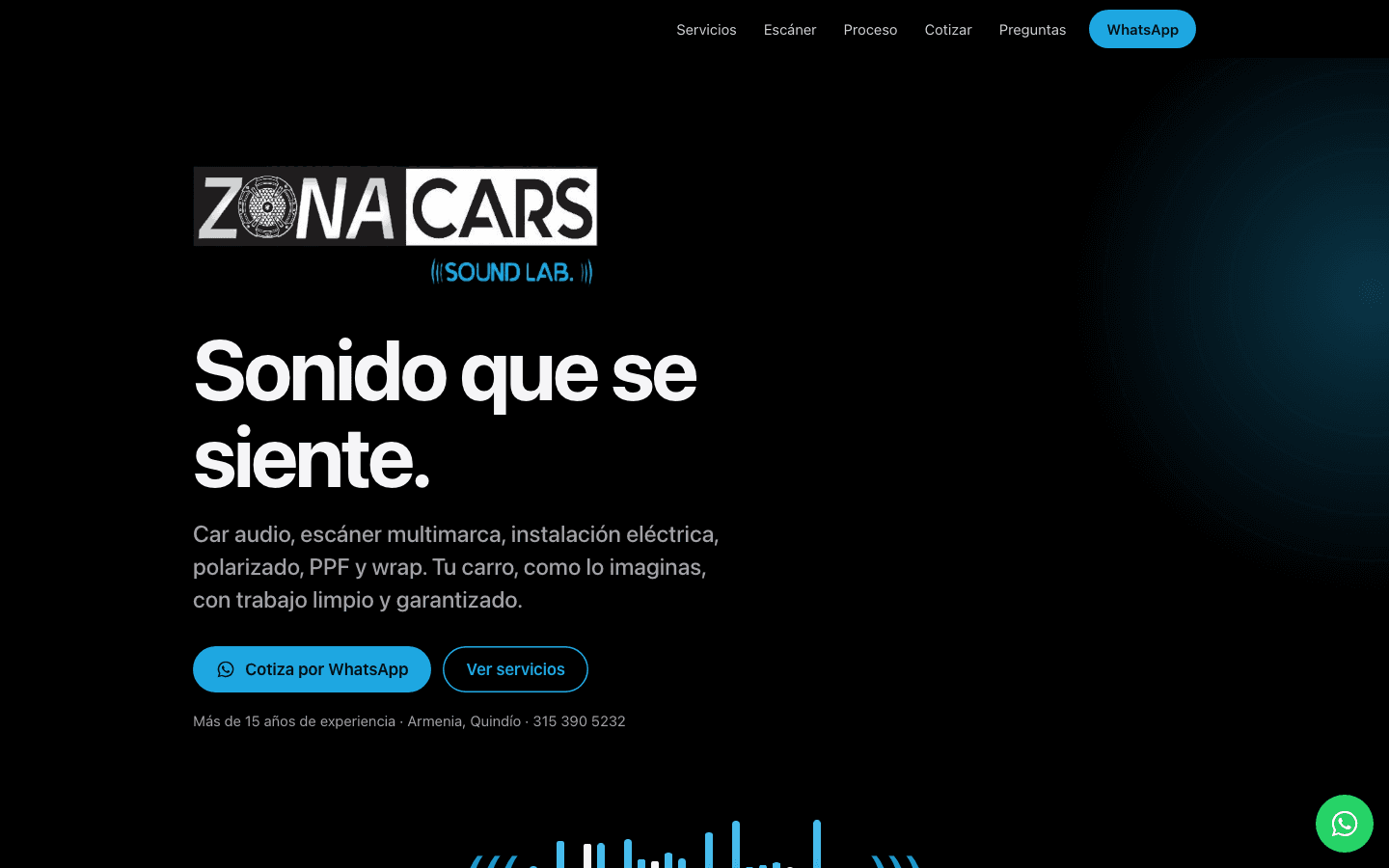
ZONACARS Sound Lab installs car audio, tint, paint protection film, wraps, LED lighting and Android head units, and runs multi-brand diagnostics, in Armenia, Colombia. The site presents the nine services, lets a visitor build a quote request that opens in WhatsApp, and reports every contact as a conversion to Google, Meta and TikTok with the campaign that brought the visitor.
Problem
The shop gets its customers from Instagram and was about to pay for ads. It needed one page that answers the usual questions, gets people into a WhatsApp chat with the details already written, and tells each ad platform which campaign produced a contact — within Colombian data-protection rules, which require consent before tracking cookies.
What it is
A single static page plus legal pages — privacy (Law 1581 of 2012), terms (consumer statute, Law 1480 of 2011) and cookies — served by Vercel with no build step. There is no framework and no server: HTML, one stylesheet and two scripts, one of which holds nothing but configuration.
The page runs in the order a customer decides: services, a section for the new diagnostic scanner with the 30 brands it covers, why this shop, the four-step process, a link to the work on Instagram, the quote form, and frequent questions about price, timing and whether tint is legal.
Every path ends in a written WhatsApp message
Each service card has its own button, and each button opens WhatsApp with a message that already names the service. The quote form collects name, vehicle and the services of interest, writes them into a message with a line authorizing the use of the data, and opens it in WhatsApp; nothing is stored on a server.
- The form asks for at least one service and moves focus to the checkboxes when none is chosen.
- The consent checkbox links to the privacy policy and is required by the browser before the message is built.
- A floating button and the header keep WhatsApp one tap away on a phone.
Measurement that waits for consent
Google tags load on every visit, but in Consent Mode v2 with storage denied by default and ad data redacted, so they work without cookies until the visitor decides. The banner offers Accept, Reject and Choose; the choice updates Google's consent state and, only for advertising, injects the Meta and TikTok pixels.
Two events count as conversions: contact_whatsapp on any WhatsApp button, with the service and where on the page it was clicked, and generate_lead when the form is sent. One function maps them to each platform's own name — Contact and Lead for Meta, Contact and SubmitForm for TikTok — and, when a Google Ads label is set, sends the Ads conversion too.
- utm_* parameters and gclid, fbclid and ttclid are saved in the session on arrival and merged into every event.
- Scroll depth at 50% and 90% is sent as an event for remarketing audiences.
- Every measurement ID lives in one config file; an empty ID means that platform is never loaded.
Found by people nearby
The page declares the shop as a Schema.org AutomotiveBusiness with address, coordinates, Google Maps link, service area, phone, social profiles and each service as an offer. Titles and copy name the city and the region, and the contact block links to the Maps listing and to the form for leaving a Google review.
Architecture
Technical decisions
- No framework, no build
- The page has no data to fetch and no state to share. Plain HTML loads fast on a phone, deploys on every push and can be edited by anyone who can open a file.
- Google cookieless by default, pixels only on consent
- Consent Mode lets Google model conversions without cookies, so measurement does not start at zero for people who ignore the banner. Meta and TikTok have no equivalent mode, so their scripts are not requested at all without consent.
- One event, three dialects
- Buttons call one function with a neutral event name. Translating it to each platform there means adding a platform touches one place, and a renamed event cannot drift between GA4 and Meta.
- WhatsApp instead of a lead database
- The shop already answers on WhatsApp. Sending the request there avoids storing personal data the business would then have to protect, and the conversion is still counted.
Evidence
9
Services, each with its own WhatsApp message
Source: index.html
30
Vehicle brands listed for the diagnostic scanner
Source: assets/img/brands
3
Ad platforms that receive the same conversion events
Source: assets/js/main.js
Limitations
- The measurement IDs are not set yet, so no platform receives data until the accounts are created.
- The business's legal details (tax ID, address, email) are still placeholders in the privacy policy and terms.
- The consent choice lives only in the visitor's browser; there is no server-side record of it.
- There are no automated tests.