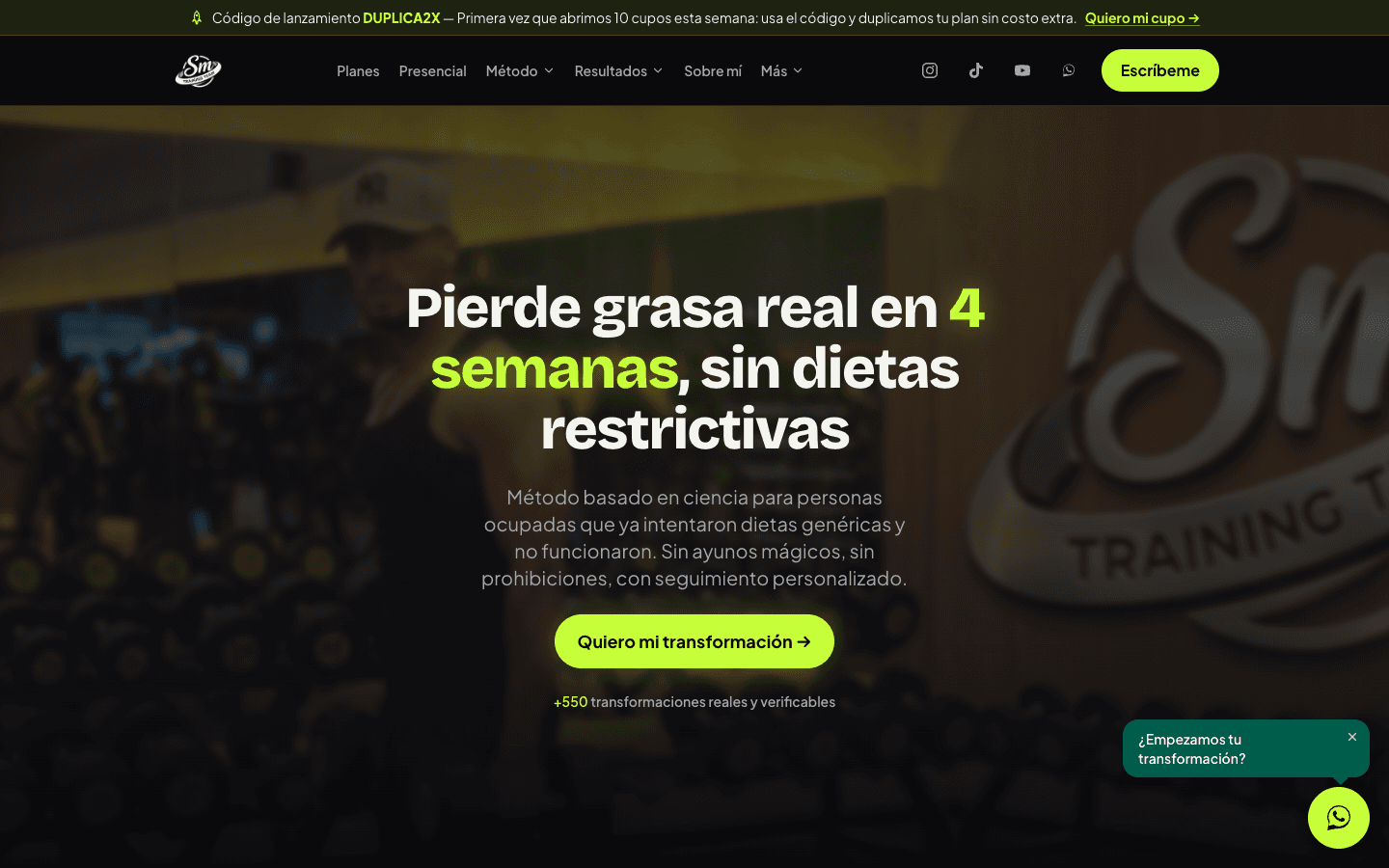
Overview
Santiago Entrenador is the live site of a fat-loss coach. It has one job: move a visitor who arrives from Reels or TikTok into a WhatsApp conversation. It also takes online payments to reserve a spot, with the amount fixed and signed on the server.
Problem
Short-video traffic arrives on a phone with little patience. The page has to earn trust quickly and make the next step a single tap, without a backend for the client to maintain.
What it is
A single-page React application with no server-side rendering or routing, because one page does not need them. All copy and data — cases, FAQ, process steps, plans — live in one constants file, so content changes without touching a component.
Beyond the usual hero, plans and FAQ, it includes a pitch video, a gallery of client cases, a weekly-progress section, an in-person training section with a waitlist, a body-composition calculator and a discount wheel.
Payments
Reservations are paid through Wompi's hosted checkout. A button links to /api/checkout?product=<id>; the function checks the id against a catalog that lives on the server, sets the amount, builds a unique reference and signs it with SHA-256 and the integrity secret before redirecting.
When the visitor returns, the page calls /api/payment-status, which asks Wompi for the real state of the transaction. The transaction id is validated first, and sandbox or production is chosen from the key prefix.
Lead capture and measurement
Every call to action opens WhatsApp through a deep link with a prefilled message. An optional form posts name and number to a webhook, which can feed a CRM or a spreadsheet.
Each button reports where on the page it was clicked to Google Analytics 4 and Meta Pixel when their ids are configured, so conversion can be read per section.
SEO
The static HTML carries the canonical URL, Open Graph tags and structured data describing a professional service, its provider and its offer, plus a sitemap and robots file.
Accessibility and motion pass
- Honors the system's reduce-motion and increase-contrast settings.
- Visible keyboard focus ring; Escape closes menus and the image lightbox.
- Larger hit areas on carousel controls and higher contrast for idle and disabled states.
- Labeled form fields with autocomplete and a success message.
- Removed scroll snapping, perpetual glows and hover tilt on static cards.
Architecture
Technical decisions
- A single-page app, not a server framework
- One page needs no server rendering or routing. A static build is cheaper to host and leaves the client nothing to operate.
- Amount and signature on the server
- The browser only sends a product id. The amount comes from a server-side catalog and the integrity signature needs a secret the browser never sees, so a visitor cannot change the price.
- Verify instead of trusting the return URL
- Anyone can type a success URL. The page asks the payment provider for the transaction's state and shows “approved” only when the provider says so.
- Degrade to WhatsApp
- If payment keys are missing, the checkout function redirects to a WhatsApp message with the chosen product, so a reservation is never lost to configuration.
- Remove motion that did not earn its place
- The audit dropped scroll snapping, constant glows and hover tilt, and kept a single accent on the main call to action.
Evidence
2
Payment endpoints, one to sign and one to verify
Source: api/checkout.ts · api/payment-status.ts
4
Paid products in the server-side catalog
Source: src/lib/checkoutProducts.ts
Limitations
- There are no automated tests and no CI.
- It is a client-rendered application: the content depends on JavaScript, while the meta tags and structured data are in the static HTML.
- Payment state is checked when the visitor returns; there is no server-side webhook that records payments.
- The figures and client stories shown on the site are the client's own content; this case study makes no claim about them.